Twice-Exited Tech Founder Taps Into UK’s Most Powerful Supercomputer to Unearth Regional Breakthroughs
Half of the UK’s deep-tech innovation happens outside London, often hidden in complex regional research clusters that investors and corporate scouts struggle to monitor. Unearthing these breakthroughs, and the people and companies working on them, requires sorting through millions of data points including academic papers, grants and ecosystem stakeholders - a task perfectly suited for AI, but bottlenecked at scale by the high per-token costs of commercial large language models.
Now, Bath-based innovation intelligence startup Placeful is breaking that bottleneck.
Led by twice-exited tech founder Luke Loveridge, Placeful has secured compute allocation on Isambard-AI through the UK's AI Research Resource (AIRR), via the Rapid Access route. The initiative aligns perfectly with the national agenda to build and retain world-class artificial intelligence infrastructure and talent domestically, while building a highly accurate, fiercely cost-effective engine dedicated to deep-tech discovery.
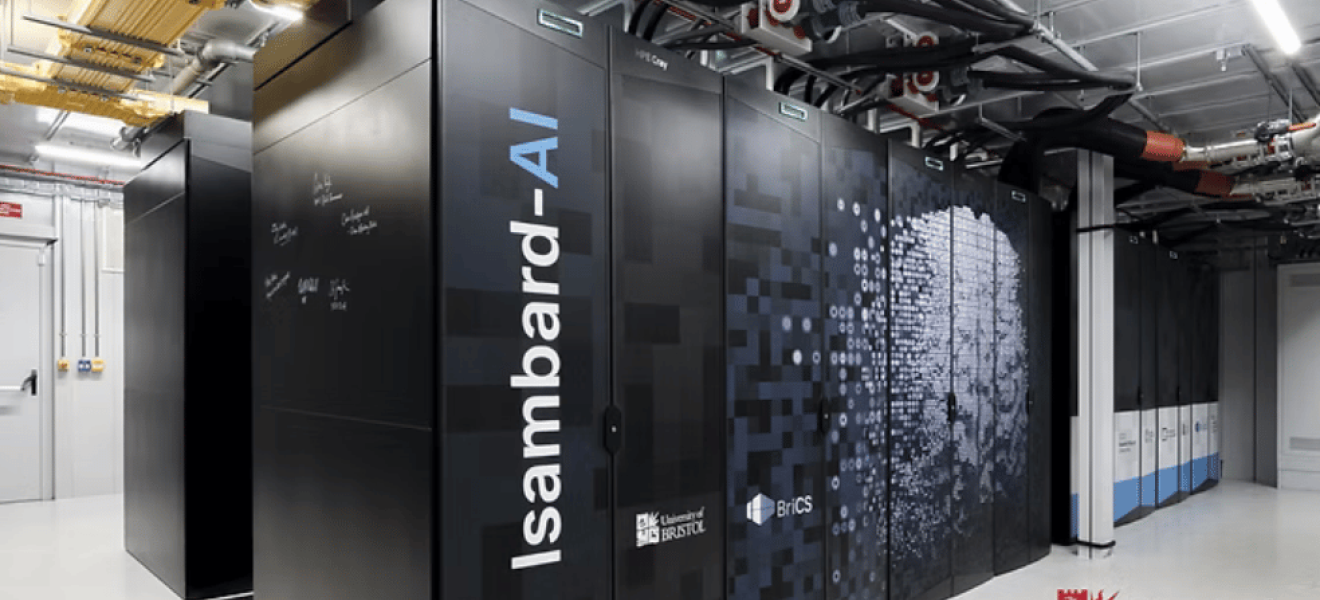
Running through January 2027 at the Bristol Centre for Supercomputing (BriCS), the project tests a bold premise: can self-hosted, open-weight AI models match the accuracy of expensive commercial giants on a specific innovation dataset? By benchmarking the world’s leading open models on Isambard-AI - an absolute powerhouse packing over 5,000 NVIDIA GH200 Grace Hopper Superchips capable of 21 exaflops of AI performance - Placeful is distilling the best performers into a lean, low-cost model capable of running entirely on UK-sovereign cloud infrastructure at Civo.
Crucially, early benchmarks prove the project's core thesis: these compact, open models are performing within just a few percentage points of their massive commercial counterparts at a fraction of the cost.
To unearth hidden regional breakthroughs, Placeful’s AI actively reads between the lines of millions of academic papers and grants to extract critical insights including technology readiness, dual-use potential, and early spin-out signals. This deep intelligence enables investors, corporate innovation, and public-sector teams to spot emerging capabilities long before they hit the market.
Placeful is initially applying this engine to autonomous systems, unveiling the results through a series of monthly ‘Early Signal’ webinars via LinkedIn. Following the successful mapping of the UK's marine autonomy sector on the 5th November 2026, upcoming monthly briefings will present the findings for air and land autonomy, before the system's focus expands to track early-stage breakthroughs in climate tech and health tech.
Luke Loveridge, Founder of Placeful, commented: "Per-token costs on commercial AI quickly become the limit on how far you can go. Isambard-AI lets an innovative company like ours do in weeks what would otherwise take months and years as well as a large budget: test the world's best open models side-by-side at full scale for a specific task, and turn the winner into something cheap enough to run every day on UK-sovereign infrastructure. That’s what lets us look beyond obvious places and beyond a single sector, putting regional deep-tech capability directly in front of the people who can back it."
Andy Hazell, User Engagement Manager at the Bristol Centre for Supercomputing, added:
“Isambard-AI was built to give UK researchers and innovators access to AI compute that would otherwise be out of reach. We’re really pleased to be supporting Placeful, led by a serial tech entrepreneur, as they use the AI Research Resource to make AI-driven research discovery more affordable and sovereign, while shining a light on deep-tech capability across the UK’s regions."