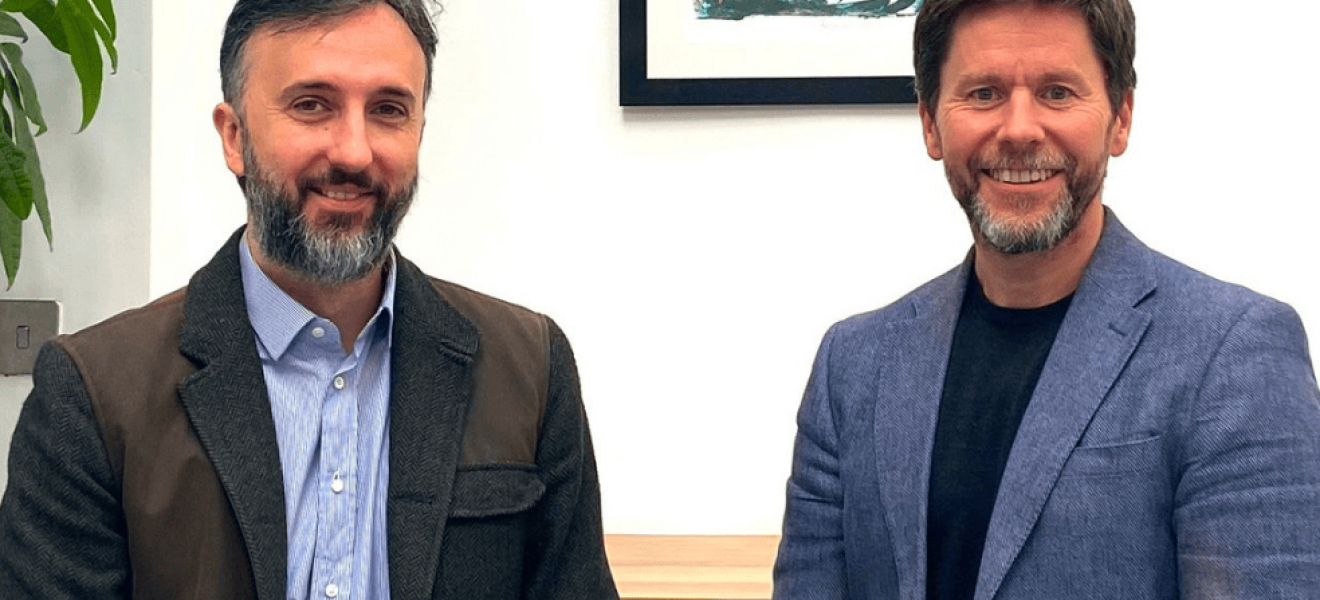
A bright future: SWIG Finance supports 21st century technology to the tune of £500,000
A Bristol company developing and prototyping technology capable of sending data at the speed of light is forging ahead thanks to loans equalling half a million pounds, courtesy of SWIG Finance.
Duality Quantum Photonics is dedicated to finding a 21st century solution to a 21st century problem: the speed and energy required to carry out the hundreds of billions of operations that make life in 2026 run smoothly.
While silicon chips revolutionised micro-electronics in the 1970s and the evolution of algorithms and software development in the following decades, Professor Anthony Laing claims it’s no longer the best material for data movement. “By modern standards, it’s incredibly slow,” he explains.
“The number of transistors per chip has doubled every two years, enabling devices to get smaller, more powerful and cheaper; but we’ve reached the point where it’s not physically possible to get more transistors into a silicon chip.”
The consequences of such patchy signal processing range from minor inconvenience – a video call losing sound or an online movie suddenly pixelating – to life-threatening decision-making in areas such as health and aviation.
Enter thin film lithium niobate (TFLN), dubbed the silicon of photonics – the science of light. Duality Quantum Photonics’s chips use TFLN, and encode data into light to be processed in nanoseconds. Chips are designed at the company headquarters at the SquareWorks tech hub in Clifton, and, made at Southampton University then brought back to Bristol for testing.
“The whole point of using light is that we can process information faster - not just 10 per cent faster, but hundreds of thousands of times faster - at the speed of light,” says Anthony.
Energy efficiency is an added bonus: “We all know the amount of power required to run data centres is on a huge scale. It takes a picojoule to move a bit of data - not much on its own, but it mounts up. If we process data photonically, we use much less energy.”
Anthony’s own journey into the sciences at the turn of the millennium was unconventional. “I had no A levels, and no formal scientific training,” he recalls. “After a few dead-end jobs, I had found myself at the start of a secure career in IT, but I kept asking myself if that was what I wanted to do for the rest of my life.
“What inspired me to give up that job was wanting to understand the nature of the universe. What is time? Why does time pass? Can we go backwards and travel to a different point in time?”
A big movie fan, Anthony spent long childhood summers watching sci-fi movies: Back to the Future, Terminator, 2001, Star Trek. "They blew my mind, and when something fires your imagination in that way, it can be a powerful drive.”
He arrived at Bristol University as a mature student in 2001. “They were nonchalant about my lack of qualifications. If films made me think about the possibility, Bristol made it a reality.”
Having studied A level maths and physics at home, Anthony embarked upon a degree in astrophysics with a foundation year, and then switched to quantum physics for his PhD. He figured out “how to write high-impact papers the way the Beatles wrote chart-topping songs”, then won a fellowship and £1m research funding, and directed a research centre of more than 100 people.
“I came in as an apprentice and went on a journey,” he says. “It reached a point where I was aware there was something you could do with your ideas other than publishing papers - you can turn them into things that make a difference to society.”
Duality Quantum Photonics was launched in 2020 with his old friend, fellow PhD student and physics professor Alberto Politi, now at Southampton University. Today, it has 20 employees and customers including Microsoft, BT, the UK Atomic Energy Authority and a range of other SMEs and start-ups.
Their aim is the make the UK the go-to nation for this new technology. “Photonics is the next chip revolution, and it makes huge strategic sense for the UK to invest resources in this technology,” says Anthony. “It has to exist somewhere, and we want it to happen here. That’s what we are working hard to do.”
The SWIG Finance funding was delivered in two halves: one in August 2023 to fund the employment of two key personnel - a business director and operations director – and facilitate the expansion from shared to dedicated office space; and the second in July 2025, to hire senior staff including a vice president of chip and processor sales, enable the continuation of research and development and provide working capital while navigating the intended increase in sales.
“Without SWIG Finance, we could not have brought our chip design and fabrication service to market - that’s the truth,” says Anthony.
“The journey we’re on is not risk-free; on the contrary, deep tech innovation comes with risk. We needed a partner willing to take that risk for the greater good SWIG Finance allowed us to innovate towards commercial technology, and increasing our cash runway gave us time to develop our ideas into products.”
SWIG Finance business manager Jim McLaren said: “It was great that SWIG was able to help Duality Quantum Photonics. I’m no expert, but from what I’ve read, the quantum technology industry has been placed as a key focus by the UK government for the future success of its economy, and it’s wonderful to see a Bristol-based company at the forefront of making this happen.
“Anthony, Alberto and the team were a pleasure to work with to get this funding in place, and the success which I’m sure will continue to come to them is well-deserved.”